

ChatGPT Never Admits When It Doesn't Know The Answer. Here Is Why
Most people think ChatGPT works like Google or an encyclopedia But it doesn’t. This post explains why AI struggles to say ‘I don’t know,’ and where hallucinations come from.

A big thank you to this edition’s sponsor—Hubspot

Explore the reimagined HubSpot Marketplace
Our intelligent marketplace uses AI to analyze your business, instantly surfacing the most relevant apps, agents, and partners. Get personalized recommendations that understand your business needs and deliver fast results – without the endless scrolling.
When I was a kid, I thought my dad knew everything.
I’d ask him all the big, unanswerable questions of a five-year-old:
Why is the sky blue?
Why do dogs bark?
Why do airplanes fly and cars don’t?
Sometimes, he’d have an answer right away. But other times, he’d pause, think for a second, and tell me the most honest thing a human can say: “I don’t know.”
That’s what people do. We admit when we’ve reached the point where we don’t know the answer.
But here’s the weird part.
When you use ChatGPT, you expect the same behavior. You expect it to behave like us.
If it knows, it should answer; if it doesn’t, it should say, “I don’t know.”
But it never does.
Instead, it gives you a beautiful, polished, and confident-sounding response. A response that looks and feels right.
But sometimes, it’s completely wrong.
And then people get frustrated. They call it “lying.” They accuse it of making things up.
They wonder why a system so advanced can’t do the simplest human thing imaginable: just admit when it doesn’t know.
That question is a recurring theme on the internet. And for anyone in the product or tech world, understanding the answer is very important if you’re using AI or building AI products.
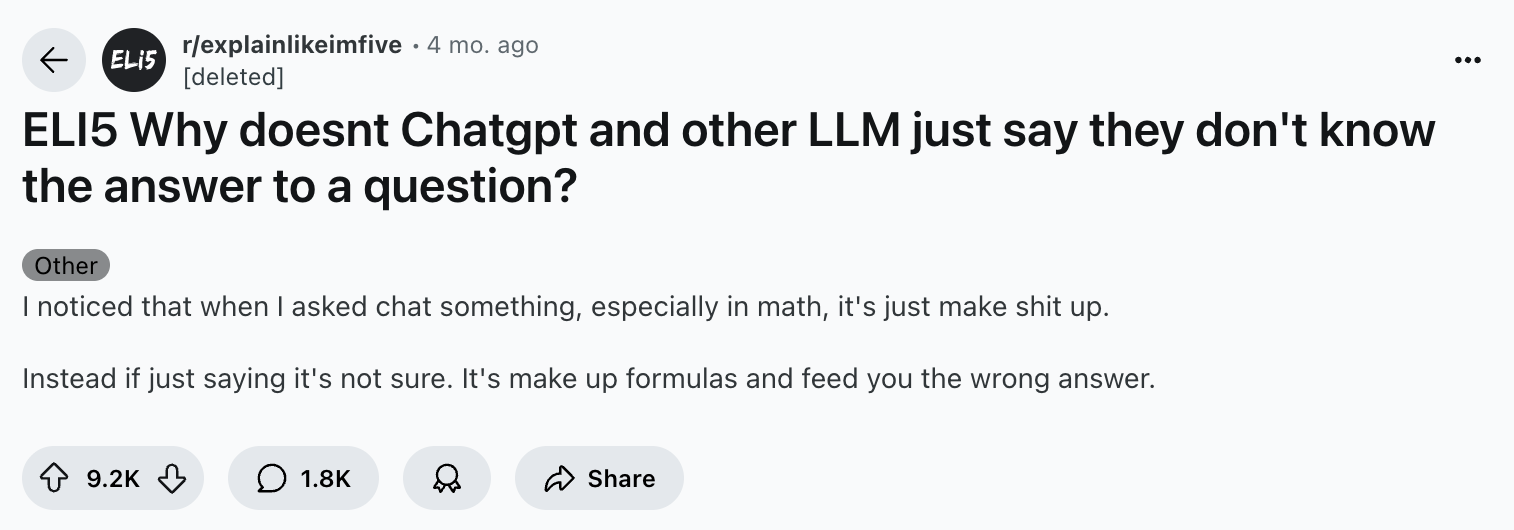
The Way We Think About AI Is The Main Problem
Many people imagine ChatGPT as a big encyclopedia that knows all the facts and can answer all questions accurately based on its knowledge.
But that’s not how ChatGPT or an LLM works. Not even close.
And this wrong mental model is why so many people get shocked when ChatGPT responds with something that looks correct but is completely wrong.
So What Are LLMs?
An LLM isn’t an encyclopedia. It isn’t Google search. And it definitely isn’t a person with facts stored in their head.
At its core, an LLM (large language model) is a next-word prediction machine.
Simply put, it’s a sophisticated auto correct tool.
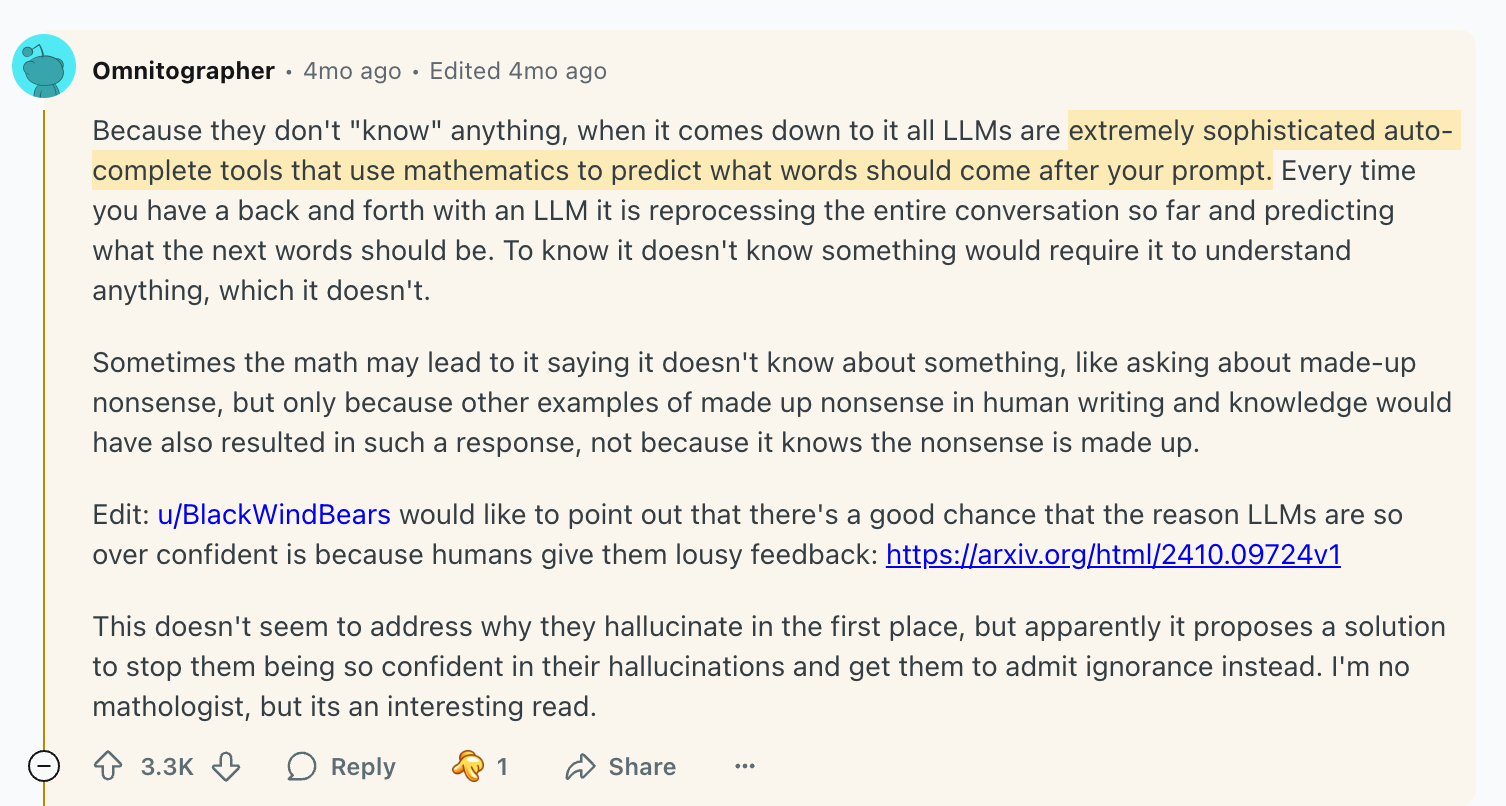
You give it some words. It predicts the most likely next word. Then the next. Then the next. Over and over, thousands of times per second. That’s what it is good at.
If you write the phrase, “Peanut butter and ___,” your brain instantly fills in “jelly.” Because that’s the most likely continuation.
That’s what an LLM is doing. Not just for “peanut butter,” but for every possible sentence, paragraph, or essay you could ask for.
This is why it can produce Shakespearean sonnets, working Python code, or a grocery list in perfect English. It’s just running probability math over language.
But it’s important to know what’s missing.
There is no internal map of truth.
There are no “facts” stored like in a database.
There is no “knowing” if it is accurate or not.
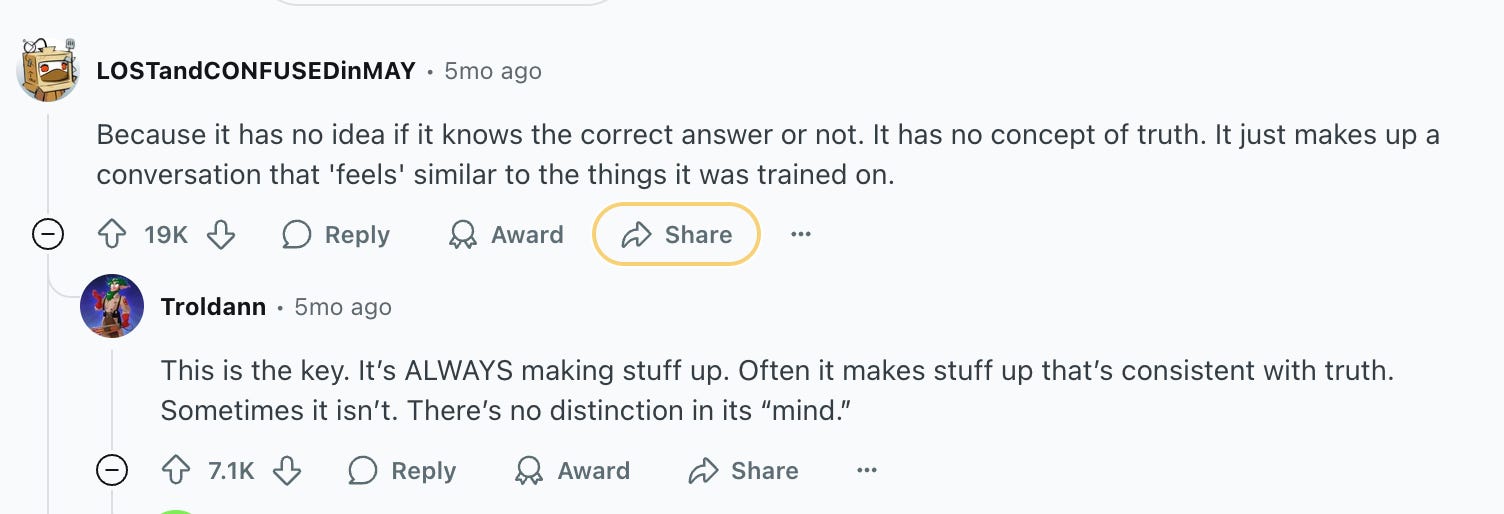
This is the first big mental shift you need to make: ChatGPT is not retrieving information or facts. It is predicting words.
So Why Doesn’t ChatGPT Ever Say “I Don’t Know”?
Because ChatGPT’s language model is built to keep guessing the next word, it doesn’t naturally stop and say “I don’t know.”
The loop is built to continue.
And in most chat interfaces, it has no simple way to admit uncertainty, like saying “I’m only 30% sure, so I’ll stop.” Instead, it just keeps guessing the next words that look like they fit, even if it isn’t confident.
Now, a simple example with high confidence.
If you ask, “What’s the capital of France?” the model has seen this pattern millions of times. “The capital of France is Paris” is the highest-probability continuation, so that’s what you get. It feels like knowledge, but under the hood it’s just probability doing its job.
An example with uncertainty.
Imagine you ask something unusual, like “When did the smallest kingdom in Europe first issue coins?” The model won’t stop and say it doesn’t know. It will still generate an answer that seems relevant (and correct.) Sometimes that answer will be right. Other times, it will be close. And sometimes, it will be completely wrong.
Why it can’t just say how sure it is.
On the inside, ChatGPT does keep track of how likely each word is. But it can’t show that probability in a message like “I’m 62% sure, this is the answer” to the users.
All AI apps we use are powered by similar or the same models. And they also don’t show this probability to end users. So what you see is always the same: a perfectly crafted answer, even if the system isn’t sure it is the right one.
And this is where hallucinations come from.
When ChatGPT gets a question it has not practiced much, it still tries to answer. It keeps guessing the next words, even if it does not really know. Sometimes the guess is right. Sometimes it is not. When it sounds correct but is wrong, we call that a hallucination.
Put together, here’s the flow you can expect:
You ask a question.
The model predicts the most likely next words.
If the pattern is strong (like “Paris”), the answer feels factual.
If the pattern is weak, it still continues with lower internal confidence you never see.
Sometimes it lands. Sometimes it misses. The misses are the “made‑up” parts.
That’s why it rarely says “I don’t know.” Not because it’s stubborn or sneaky, but because the machine is built to continue, not to stop.
The behavior isn’t a glitch. It’s the natural outcome of a system whose first principle is prediction.
The Problem Isn't The System. The Problem Is Us.
We keep projecting human qualities onto ChatGPT.
We assume it thinks. We assume it knows.
So when it gives us a wrong answer, we feel betrayed.
We think, “Why didn’t it just admit it didn’t know?”
But that’s the wrong question.
Because the model isn’t lying.
It isn’t withholding.
It’s doing exactly what it was built to do: keep guessing the next word, over and over.
The real mistake is in our mental model. We want it to be a librarian, a teacher, a fact-checker.
But it’s none of those things.
It is a very powerful autocomplete.

The Wrong Way to Use It
If you treat an LLM like a fact engine, you will get burned.
You’ll ask it for numbers, citations, or exact quotes. It will confidently give you something. And sometimes, that something will be a fabrication. Not because it’s "lying," but because that’s what a prediction machine does. It produces plausible-sounding text, not guaranteed truth.

That's why engineers are building products with an additional layer on top of the LLM: a process called Retrieval-Augmented Generation (RAG).
What is RAG
RAG is a way to help ChatGPT stay closer to facts.
It works by giving the system a set of trusted documents to read first. Then, when you ask a question, it can pull details from those documents and build its answer on top of them. You can think of it like giving a student notes before a test. They still have to write the answer themselves, but now they have reliable material to look at.
This makes the answers better, but deep down ChatGPT is still a prediction tool, not a fact checker.
The Right Way to Use It
So how should you use ChatGPT?
Not as a fact-checker. But as a collaborator.
LLMs are incredible at:
Brainstorming.
Drafting.
Exploring options.
Offering possibilities you hadn’t thought of.
Think of ChatGPT as a helper that can quickly give you lots of ideas. Some ideas will be good. Some will not make sense. But if you know that, you can use it in the right way: for rough drafts, early ideas, or quick outlines.
The moment you need facts, you add a layer of human verification, or you use a tool built with that RAG layer.
Conclusion
The point isn’t whether it says, “I don’t know.”
The point is this:
LLMs are not knowledge engines. They are text prediction engines.
And until you make that mental shift, you’ll keep asking the wrong questions. You'll keep asking for certainty from a machine built for possibility.
So the next time it gives you a weird, confident, and wrong answer, don’t get mad at the machine.
Look in the mirror.
And ask yourself what you expected.
Until next time
—Sid
Best explanation of hallucinations ever!